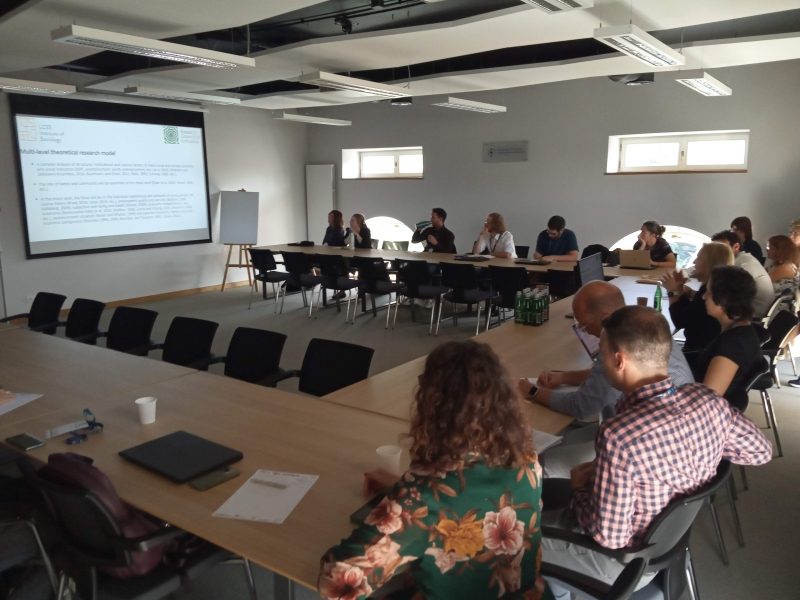
On May 15, 2026, the Baltic regional sociology conference “Baltic Readings 2026” was held in Vilnius. Organized by the Institute of Sociology at the Lithuanian Centre for Social Sciences (LCSS), the Lithuanian Sociological Association, and the Lithuanian Academy of Sciences, with support from the International Sociological Association (ISA), the conference sought to revive a long-standing tradition of academic collaboration.
Category: Main
Join the research community at the Institute of Sociology, Lithuanian Centre for Social Sciences, by pursuing a PhD in Sociology.
Application deadlines: 7 August 2026 / 24 August 2026.
Regional Baltic Sociology Conference
“Baltic Readings 2026”
Reviving the longstanding tradition of ‘Baltic Readings’, the conference aims to strengthen regional cooperation and promote collaborative research on shared social, cultural, and political issues in the Baltic context. It offers a unique opportunity to advance the Baltic sociological community and its scholarly impact.
- Institute of Sociology at the Lithuanian Centre for Social Sciences;
- Lithuanian Sociological Association;
- Lithuanian Academy of Sciences.
Supported by the International Sociological Association (ISA).
Organising Committee:
- Diana Janušauskienė (Chair);
- Andrius Marcinkevičius;
- Aušra Maslauskaitė;
- Sarmitė Mikulionienė;
- Inga Gaižauskaitė;
- Giedrė Plepytė-Davidavičienė;
- Monika Frėjutė-Rakauskienė;
- Anna Lipnevič;
- Kornelija Čepytė-Eivė;
- Inga Nomeikienė;
- Kamilė Botyriūtė;
- Agnieška Avin-Ileri;
- Veronika Žvirblė.
The Regional Baltic Sociology Conference ‘Baltic Readings 2026’ brings together sociologists from Lithuania, Latvia, Estonia, and beyond to reflect on the current state and future directions of sociology in the Baltic region. Organised by the Lithuanian Sociological Association, the Institute of Sociology at the Lithuanian Centre for Social Sciences, and the Lithuanian Academy of Sciences, and supported by the International Sociological Association (ISA), the conference provides a platform for scholarly exchange and networking.
Reviving the longstanding tradition of ‘Baltic Readings’, the conference aims to strengthen regional cooperation and promote collaborative research on shared social, cultural, and political issues in the Baltic context. It offers a unique opportunity to advance the Baltic sociological community and its scholarly impact.
The European Commission has awarded funding to the doctoral network project “Future leaders in ageing and digitalising societies – Digi4Age”, submitted by the Lithuanian Centre for Social Sciences (LCSS) in partnership with other institutions. The project will support the doctoral school in sociology by funding three PhD positions for a period of three years.
“Digi4Age” is funded under the European Commission’s Marie Skłodowska-Curie Actions (MSCA) Doctoral Networks programme. MSCA Doctoral Networks are one of the most prestigious programs of the European Commission, financing international, interdisciplinary, and cross-sectoral doctoral studies and research.
Application deadline: March 30, 2026. Studies will begin on October 1, 2026.
The Institute of Sociology at the Lithuanian Centre for Social Sciences is a member of the project “Participatory Approaches with Older Adults (PAAR-Net)”. PAAR-Net is an international research network supported by the COST Action (CA22167) and coordinated by Jagiellonian University in Kraków, Poland.
PAAR-Net is dedicated to rethinking how older adults are involved in research, policymaking, and practice. The project promotes a vision of science that is inclusive, collaborative, and people-centered—science for the people, by the people.
The Institute of Sociology at the Lithuanian Centre for Social Sciences is a member of the prestigious international DIGI-net network, coordinated by Mendel University in Brno (Czech Republic). DIGI-net focuses on the impact of digitalisation on labour market inequalities in later life. Across Europe, labour markets are undergoing a digital transformation influenced by information technology, robotics, artificial intelligence, and automation. However, the level of digitalization varies significantly between European countries. At the same time, the proportion of workers aged 50 and over who remain in the workforce longer than in the past is increasing. Despite this, there is still a notable lack of research on how digitalization affects older employees. DIGI-net seeks to address this complex issue through comprehensive research.